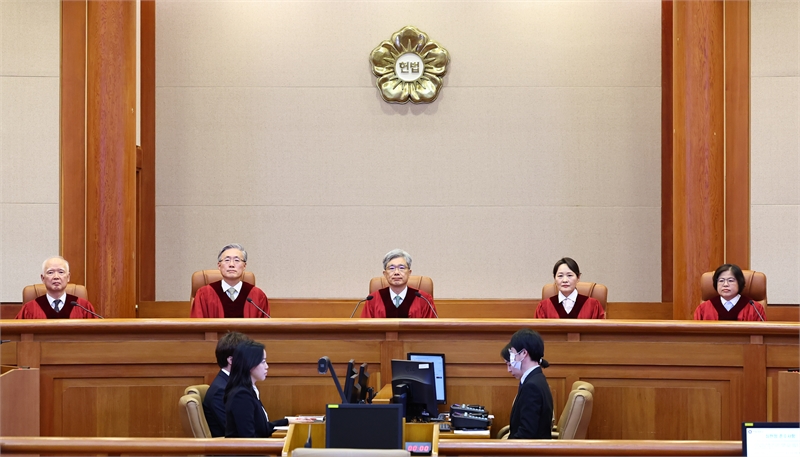
김상환 헌법재판소장과 헌법재판관들, 서울 종로구 헌재 대심판정. 2025.11.27.
헌법재판소가 음주운전 금지규정을 3회 이상 위반한 운전자를 가중처벌하는 법률 조항이 헌법에 어긋나지 않는다고 판단했다.
1일 법조계에 따르면 헌재는 지난달 27일 A씨가 제기한 도로교통법 148조의2 1항 1호에 대한 헌법소원 사건에서 재판관 전원일치 의견으로 합헌 결정을 내렸다.
A씨는 2018년 8월 혈중알코올농도 0.153% 상태에서 무면허 운전을 한 혐의로 기소됐다. A씨는 과거 두 차례 음주운전 혐의로 징역형 집행유예를 선고받은 전력이 있어 가중처벌 대상이 됐다. A씨는 재판 도중 해당 법률 조항에 대해 위헌법률심판제청을 신청했고, 법원이 이를 받아들였다.
헌재는 음주운전 가중처벌 조항이 책임과 형벌 간 비례원칙에 위배되지 않는다고 판단했다. 헌재는 "심판대상조항은 거듭되는 음주운전 행위의 불법성 및 비난가능성에 상응해 처벌의 실효성을 확보하기 위한 것"이라며 "3회 이상 음주운전자에 대해 가중처벌하는 것은 합리적 이유가 있다"고 밝혔다.
헌재는 "반복적 음주운전은 교통안전을 위협하면서 사회구성원의 생명·신체·재산을 거듭 위험에 처하게 하는 무분별한 행위이고 비난가능성이 매우 크다"고 지적했다. 이어 "특히 음주운전 금지규정을 3회 이상 위반한 자는 교통법규 준수에 관한 책임의식, 교통관여자로서 안전의식 등이 현저히 결여되어 있고, 국민의 생명·신체·재산 및 도로교통에 관련된 공공의 안전에 심각한 위험을 초래할 가능성이 높다"고 설명했다.
헌재는 "심판대상조항은 징역형과 벌금형을 선택적으로 규정하고 있으므로, 구체적 사안에 따라 과거 위반 전력과의 시간적 간격이나 재범행위 당시 혈중알코올농도 등을 고려해 벌금형을 선택할 수 있다"고 밝혔다. 또한 "징역형을 선택하더라도 작량감경 없이 집행유예를 선고할 수 있고, 자격정지 이상 형을 받은 전과가 없다면 법률상 선고유예도 가능하다"고 덧붙였다.
헌재는 "구체적 사안에 따라 재범행위의 불법성 및 비난가능성에 차이가 있더라도 법관이 양형을 통해 불법의 정도에 알맞은 형을 선고할 수 있으므로, 심판대상조항의 법정형이 지나치게 과중하다고 볼 수 없다"고 결론 내렸다.
허재원 기자
영문 기사
아래는 위 기사를 '구글 번역'으로 번역한 영문 기사의 전문입니다. 영문 번역에 오류가 있을 수 있음을 전제로 합니다.
Title: Constitutional Court Rules Aggravated Punishment for Third-Time DUI Offenders Constitutional
Subtitle: All 9 Justices Unanimous… "Repeat Offenders Show Severely Lacking Safety Awareness"
The Constitutional Court ruled that a legal provision imposing aggravated punishment on drivers who violate drunk driving regulations three or more times does not violate the Constitution.
According to the legal community on December 1, the Constitutional Court delivered a unanimous constitutional ruling on November 27 in a constitutional complaint case filed by Mr. A regarding Article 148-2, Paragraph 1, Item 1 of the Road Traffic Act.
Mr. A was indicted in August 2018 for driving without a license with a blood alcohol concentration of 0.153%. Mr. A had two prior drunk driving convictions resulting in suspended prison sentences, making him subject to aggravated punishment. During the trial, Mr. A filed a petition for constitutional review of the relevant legal provision, which the court accepted.
The Constitutional Court determined that the aggravated punishment provision for drunk driving does not violate the principle of proportionality between responsibility and punishment. The court stated, "The provision under review is intended to ensure the effectiveness of punishment in accordance with the illegality and culpability of repeated drunk driving," adding, "There is reasonable justification for imposing aggravated punishment on those who have committed drunk driving three or more times."
The court pointed out, "Repeated drunk driving is a reckless act that threatens traffic safety and repeatedly endangers the lives, bodies, and property of community members, and is highly culpable." The court further explained, "Particularly, those who violate drunk driving regulations three or more times show severely lacking responsibility for traffic law compliance and safety awareness as traffic participants, and pose a high possibility of causing serious danger to public safety related to citizens' lives, bodies, property, and road traffic."
The Constitutional Court stated, "Since the provision under review stipulates imprisonment and fines as alternative options, fines can be selected based on the time interval from previous violations or blood alcohol concentration at the time of re-offense." The court added, "Even if imprisonment is selected, a suspended sentence can be imposed without discretionary reduction, and if there is no prior conviction of disqualification or higher, a suspended pronouncement is also legally possible."
The court concluded, "Even if the illegality and culpability of re-offenses vary depending on specific cases, judges can impose sentences appropriate to the degree of illegality through sentencing, so the statutory punishment of the provision under review cannot be considered excessively severe."
By Heo Jae-won